Global History: Difference between revisions
No edit summary |
No edit summary |
||
| Line 6: | Line 6: | ||
{| class="table" | {| class="table" | ||
|- | |- | ||
| [[file:surveytextbook.jpg]] | | [[file:surveytextbook.jpg|link=https://www.teacherspayteachers.com/Product/Global-History-II-World-History-Survey-Guide-Textbook-1750-to-Present-11970162]] | ||
|| | || | ||
{| class="table" style="height: 202px;" | {| class="table" style="height: 202px;" | ||
| Line 17: | Line 17: | ||
|} | |} | ||
|- | |- | ||
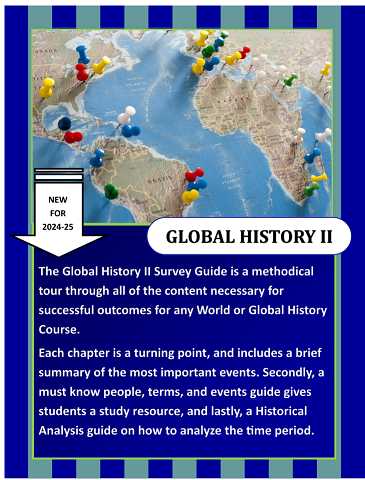
|Try our brand new product for students taking World or Global History. The Survey Guide explores Turning Points from 1750 to Present. Each Turning Point has a summary for the important events, and a study guide with Vocabulary Terms, Must Know People, and Must Know Concepts. After each Turing Point is a Historical Analysis guide for guiding students through items they can analyze for either Causes & Effects or via Comparative Analysis. | |Try our brand new product for students taking World or Global History. The [https://www.teacherspayteachers.com/Product/Global-History-II-World-History-Survey-Guide-Textbook-1750-to-Present-11970162 Survey Guide] explores Turning Points from 1750 to Present. Each Turning Point has a summary for the important events, and a study guide with Vocabulary Terms, Must Know People, and Must Know Concepts. After each Turing Point is a Historical Analysis guide for guiding students through items they can analyze for either Causes & Effects or via Comparative Analysis. | ||
|} | |} | ||
---- | ---- | ||
[[Image:previous.jpg|75px|link=Main Page]]</center> | [[Image:previous.jpg|75px|link=Main Page]]</center> | ||
Revision as of 19:21, 4 August 2024


|
| |||||||||
| Try our brand new product for students taking World or Global History. The Survey Guide explores Turning Points from 1750 to Present. Each Turning Point has a summary for the important events, and a study guide with Vocabulary Terms, Must Know People, and Must Know Concepts. After each Turing Point is a Historical Analysis guide for guiding students through items they can analyze for either Causes & Effects or via Comparative Analysis. |